


Suburb
A geographical area primarily designated for residentially oriented development that proceeds according to a general plan and professional principles of design. Often found at the edge or outside of a city and connected by convenient transportation to carry commuters into and out of the workplace.
The term “suburb” usually applies to large-scale areas containing several subdivisions and related community facilities. A “subdivision” is the subject of a single plan indicating layout of streets and lots, and may also contain amenities such as sidewalks, parks, utilities, and community facilities. Within a suburb, a “superblock” is developed as a single parcel, often to accommodate clustered or apartment housing.
Within a spectrum of variation, two major types of spatial organization underpin the layout of streets and division of lots within suburbs: curvilinear, in which streets follow topography and lots are irregularly shaped in order to present idealized communities in naturalistic settings; and rectilinear, which follow a grid presenting a consistency of pattern for street layout and lot sizes and shapes, thus offering populations visibly equitable surroundings. Each of these patterns morphed with the introduction of the car. Cul-de-sacs, mews, curves within a grid, and the arrangement of intersections all shifted accommodate or regulate speed and other safety concerns.
-

Washington Park Historic District
Troy, NY -

James Creek Dwelling
Washington, DC -

Mayfair Mansions Apartments
Washington, DC -

Williamsburg Houses
New York, NY -

Lathrop Homes
Chicago, IL -

Harlem River Houses
New York, NY -

Langston Terrace Dwellings
Washington, DC -

Lockefield Garden Apartments
Indianapolis , IN -

Forest Hill Historic District
East Cleveland, OH -
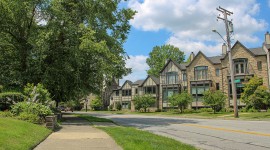
Euclid Heights Historic District
Cleveland Heights, OH -

Munsey Park
Manhasset, NY -
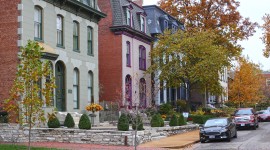
Benton Place
St. Louis, MO -

Portland Place and Westmoreland Place
St. Louis, MO -

St. Louis’ Private Places
St. Louis, MO

